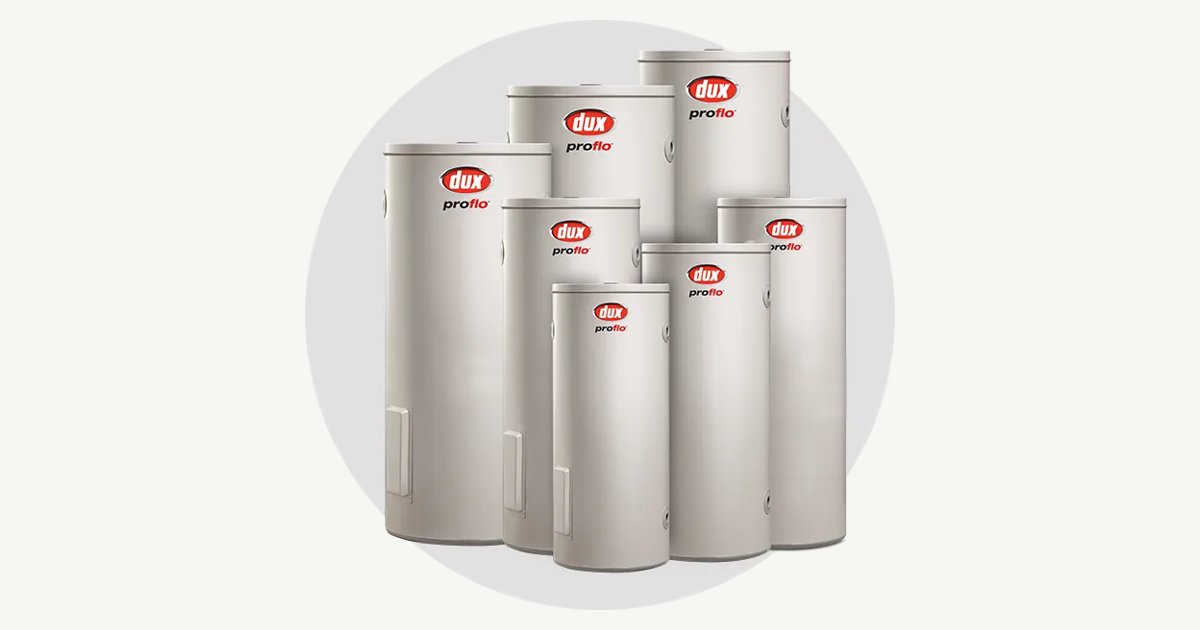
Dux sells several kinds of hot water system in Australia: electric storage tanks (including the Proflo family), gas storage, gas continuous flow, and solar and heat pump systems (including models sold under the Ecosmart name). Because the range is broad, the first decision is the type of system, not the model. Dux isn't part of Le Water's current range, but here's how to compare the options.

The main Dux system types
| Type | How it heats | Check before you choose |
|---|---|---|
| Electric storage (for example Proflo) | An element heats water in an insulated tank, often on an off-peak tariff | Tank size, and whether the off-peak hours suit your routine |
| Gas storage | A gas burner heats the tank | Recovery rate, flue and position, and your gas supply |
| Gas continuous flow | Heats water as it flows, with no tank | Flow rate for your showers, and whether your gas meter and pipes can supply it |
| Solar | Roof collectors heat the water, with a gas or electric booster | Roof direction, shade and the booster type |
| Heat pump | Uses electricity to move heat from the air into the water | Outdoor space, sound level, cold-weather running and any boost element |
Like for like, or a different type?
Replacing a failed tank with the same type is usually the quickest job, because the plumbing, the power or gas and the position are already there. Changing type takes more planning but may suit your home better over the life of the system:
- Electric storage to heat pump is a common change. A heat pump usually uses less electricity than an electric tank to heat the same water; how much less depends on the model, climate, tariff and how you use hot water.
- Gas to heat pump means a licensed gasfitter disconnects the gas unit, and an electrician may need to add a circuit.
- Any type to solar depends on a suitable roof and a booster you're comfortable running through winter.
Questions to ask about a Dux model
- What is the storage volume or flow rate, and how was it sized for our household?
- How quickly does it recover after several showers in a row?
- Where will it go, and what clearances, flue or airflow does it need?
- For a heat pump: how loud is it, and how does it perform on cold mornings?
- What electrical or gas work is needed?
- What does the warranty cover, what conditions apply, and do I need to register the product?
Current Dux models, manuals and warranty documents are on the Dux website. Older brochures may not match what's sold now, so check the document for the exact model you're quoted. For more background, read our guide to the Dux hot water heater range.
Rebates
Solar and heat pump systems may be eligible for rebates or discounts, but usually only when the exact model is on the program's approved list and the installation meets its rules. Rules change, so confirm before you buy. Our rebates page covers the programs and how we help check what may apply.
Is a Dux Proflo a heat pump?
No. The Proflo name appears on Dux electric storage tanks, while Dux solar and heat pump systems are sold under other names, such as Ecosmart. Check the full model number on the data plate to be sure what you have.
Can I replace my Dux electric tank with a heat pump?
Usually, yes. A heat pump needs an outdoor spot with good airflow, a suitable electrical supply and a drain for condensation. A site check confirms the details.
How Le Water can help
We don't list Dux in our current range. If you're open to a heat pump, compare our current range of ECONOVA, Ecogenica, Chromagen / Midea and iStore systems, and we're happy to talk through how a Dux model you're considering compares. We supply and install heat pumps across metropolitan Melbourne, with the whole job quoted in writing.